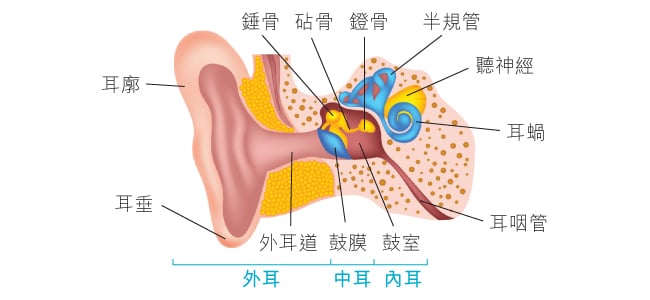
The auditory system consists of three parts: the outer ear, middle ear, and inner ear.
The outer ear includes the auricle and ear canal; the middle ear contains the eardrum and three small auditory bones; while the inner ear comprises the cochlea, which resembles a snail, and is connected to the brain via the auditory nerve. Any problem occurring in any part of the auditory system may lead to hearing loss.
Sound Transmission Process:
A healthy auditory system can detect sounds at or below 25 decibels. If sounds must be louder than 25 decibels to be heard, it is considered hearing loss.
The degree of hearing loss is categorized as mild, moderate, moderately severe, severe, or profound. Determining the level of hearing loss requires a professional and thorough hearing assessment and ear examination.
Hearing loss can be classified into three types based on its causes: conductive hearing loss, sensorineural hearing loss, and mixed hearing loss.
Conductive hearing loss is caused by damage to or blockage in the outer and/or middle ear that interferes with sound transmission. Common causes include middle ear infections, earwax buildup, eardrum perforation, or damage to the auditory ossicles.
Sensorineural hearing loss is caused by damage to the cochlea in the inner ear and/or the auditory nerve, resulting in reduced sound volume and distorted sound quality. Common causes include natural aging, bacterial or viral infections, and prolonged exposure to loud noise.
Mixed hearing loss refers to a combination of conductive hearing loss and sensorineural hearing loss. For example, when the ear canal is blocked by earwax, it can cause conductive hearing loss, while natural aging can simultaneously lead to sensorineural hearing loss.
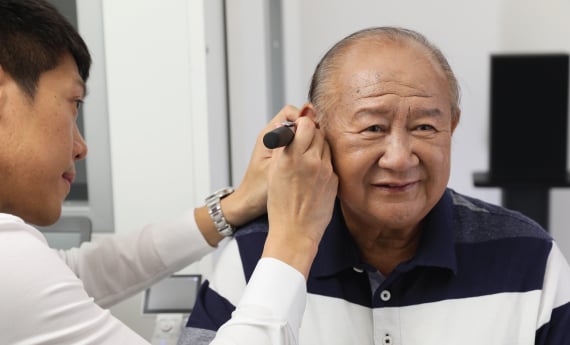
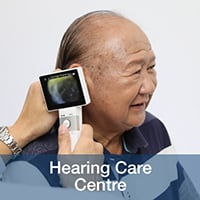
The condition of outer ear canal and tympanic membrane will be examined by using a hand-held otoscope or a video otoscope. The otoscopic exam is performed by gently pulling the auricle upward and backward. A healthy ear canal should be free of earwax and foreign body, while a healthy eardrum should be pinkish gray in color, translucent and intact. A photo of your ear canal and tympanic membrane will be shown after examination. Medical referral will be given if any abnormality such as earwax occlusion and otitis externa is identified.
Pure Tone Audiometry (PTA) is a behavioural test to assess the hearing sensitivity (i.e the softest sound) that a client can perceive in an acoustically controlled environment. The client will wear headphones or insert phones to listen different pure tones from 250Hz to 8k Hz at different loudness level. The client is instructed to respond when a sound stimulus is heard by pressing a response button or raising his/her hand. Air conduction and bone conduction thresholds will be obtained to diagnose the degree and type of hearing loss of client and identify any possible middle ear involvement.
Tympanometry records changes in middle ear immittance with varying air pressure in the ear canal. It is a test used to detect disorders of the middle ear. It involves inserting a probe tip in the ear canal to obtain ear canal volume, pressure and static compliance of the middle ear. Tympanometry may reveal possible middle ear problems, such as middle ear fluid, perforated eardrum, impacted earwax and ossicular disorders.

An acoustic reflex threshold is a middle ear measurement using a constant pressure and various frequency-specific sounds are presented at higher intensity to examine stapedius muscle contraction. Acoustic reflexes thresholds measurement can identify any possible retrocochlear lesion and help crosscheck the pure tone audioemtry and tympanometry result.
Speech audiometry provides information about the clients sensitivity to recorded or live speech materials and understanding of speech at suprathreshold levels. It can be used diagnostically to examine speech-processing abilities of the whole auditory system and identify any possible retrocochlear lesion. It can also be used to crosscheck the validity of pure-tone thresholds.
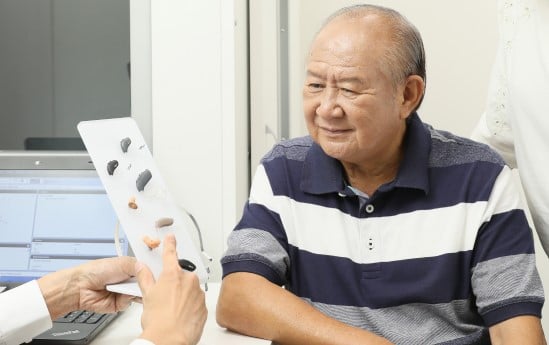
After an accurate audiological result is obtained via Comprehensive Audiological Assessments, needy clients will be evaluated for the use of hearing aid. Hearing aids with different styles and technological levels are introduced according to the degree of hearing loss, lifestyle, communication needs and dexterity of the client. Comprehensive hearing aid verification will be performed to compare the aided and unaided performance of the client and regular follow-up service is necessary for maximizing the benefit of hearing aid.
1.Medical Record Inquiry
Hearing professionals first assess the hearing condition and review the medical records.
2.Otoscopic
Using an otoscope to examine the condition of the ear canal and eardrum.
3.Tympanometry
Using a middle‑ear analyzer to assess the condition of the middle ear.
6.Hearing Aid Fitting and Functional Testing
Ensure the hearing aid provides adequate amplification and evaluate speech perception after wearing it.
5.Hearing Aid Recommendation
Recommend suitable hearing aids based on hearing level, lifestyle, and communication needs.
4.Pure-Tone Audiometry
Assess the type and degree of hearing loss.
7.One-Week Free Hearing Aid Trial
Clients may try hearing aids for free for one week and experience their effectiveness in different daily environments.
8.Post-Trial Evaluation
After the trial, hearing professionals will review the client’s adaptation during the trial period and adjust the hearing aid accordingly to ensure comfortable use.
9.Free Follow-Up Adjustment Service
Hearing may decline with age; regular adjustments and follow-up services help improve hearing aid performance.
1.Medical Record Inquiry
Hearing professionals first assess the hearing condition and review the medical records.
2.Otoscopic
Using an otoscope to examine the condition of the ear canal and eardrum.
3.Tympanometry
Using a middle‑ear analyzer to assess the condition of the middle ear.
4.Pure-Tone Audiometry
Assess the type and degree of hearing loss.
5.Hearing Aid Recommendation
Recommend suitable hearing aids based on hearing level, lifestyle, and communication needs.
6.Hearing Aid Fitting and Functional Testing
Ensure the hearing aid provides adequate amplification and evaluate speech perception after wearing it.
7.One-Week Free Hearing Aid Trial
Clients may try hearing aids for free for one week and experience their effectiveness in different daily environments.
8.Post-Trial Evaluation
After the trial, hearing professionals will review the client’s adaptation during the trial period and adjust the hearing aid accordingly to ensure comfortable use.
9.Free Follow-Up Adjustment Service
Hearing may decline with age; regular adjustments and follow-up services help improve hearing aid performance.